A new version of the Python framework will make it easier for software developers and HPC teams to emulate the performance of quantum hardware
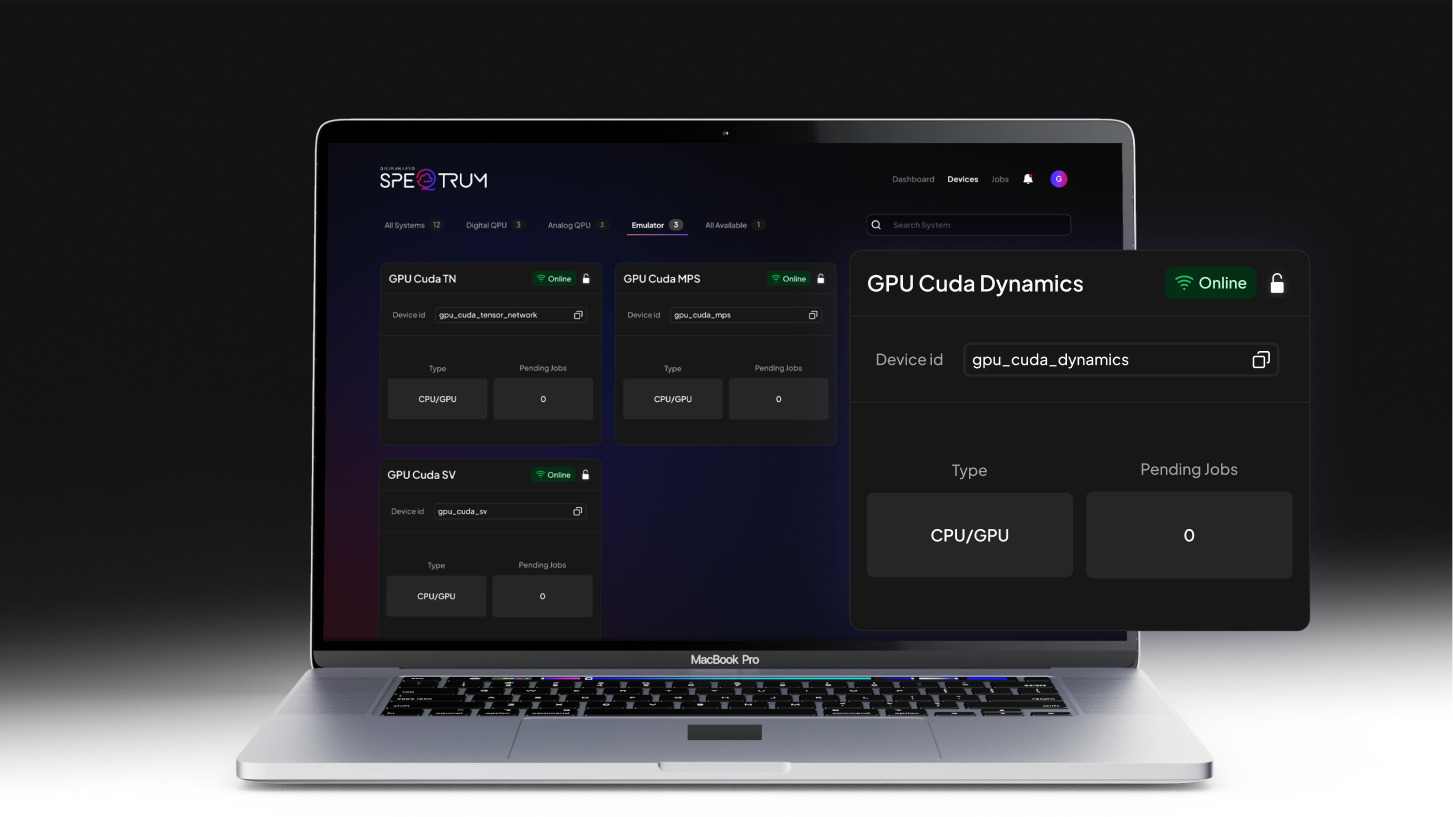
Barcelona, June 2026 — Qilimanjaro Quantum Tech’s software development toolbox called QiliSDK is now integrated with NVIDIA CUDA-Q – the platform for quantum-classical computing. This upgrade provides researchers with GPU acceleration for production-scale emulation of quantum workflows on classical hardware. Qilimanjaro’s unique multimodal approach now extends across classical and quantum backends, from CPUs and GPUs to analog and digital QPUs.
This upgrade to QiliSDK is especially relevant for HPC centers. Those users—including the team at the Barcelona Supercomputing Center where Qilimanjaro has installed three quantum computers—regularly work with NVIDIA GPUs and now can use this hardware to execute large CUDA-Q simulations directly from QiliSDK. QiliSDK allows researchers to use the same library to run algorithms on real quantum hardware (digital and analog) and execute quantum emulation on classical resources.
The future of computing will be multimodal, combining supercomputers with quantum acceleration, both digital and analog. This upgrade to QiliSDK helps users to integrate all these classical and quantum modalities under a single entry point, bringing this multimodal vision closer to reality.
Marta P. Estarellas
CEO of Qilimanjaro Quantum Tech
Most quantum software runs on a single kind of quantum hardware, either digital or analog, or on classical emulators. QiliSDK runs across multiple backends: CPU, GPU, digital QPUs (dQPU) and Qilimanjaro’s analog QPUs (aQPU). This drives Qilimanjaro’s vision of the next phase of compute: the future of supercomputing will be multimodal.
QiliSDK is Qilimanjaro’s Python framework for developing, running and emulating both digital and analog quantum algorithms. Its modular design makes it easy to prototype circuits, build Hamiltonians, design variational workflows and quantum-reservoir models, then deploy them on local or remote backends, classical or quantum.
QiliSDK now includes a complete list of CUDA-Q backends and noise models, as well as QIR and OpenQASM3 connectors. This allows users from other software libraries to port their code and benefit from the integration.
Classical emulation is a vital part of how quantum teams work. Before running anything on real hardware, teams use emulation to prototype circuits, study system behavior, characterize noise, and establish the benchmarks that quantum results are measured against. It also handles the classical side of hybrid workflows, the pre- and post-processing that wraps every quantum call. Adding the computational power of NVIDIA accelerated computing to this workflow adds more powerful tools to the process.
Every future supercomputer will draw on quantum processors to expand what’s possible with computing. To start building for tomorrow’s quantum-GPU supercomputers today, researchers need tools like QiliSDK, which taps CUDA-Q for the GPU-accelerated performance required to understand truly hybrid quantum-classical systems.
Sam Stanwyck
Director of Quantum Product at NVIDIA
Emulating a quantum state on a classical computer takes exponentially large resources as the qubit count increases. On a CPU, this can be easily achieved up to about 25 qubits before hitting the limits of memory and bandwidth. At that point, run times go from seconds to hours. GPUs are built for this kind of workload with wide memory buses, massive parallel arithmetic and multi-GPU NVLink topologies. Beyond the strength of the individual GPU, adding tensor-network or distributed-memory methods add even more capacity. NVIDIA CUDA-Q provides a platform for developing hybrid quantum-classical workflows, including the most performant way to draw upon GPU-acceleration to support quantum computing workloads.
Read more here: Technical Blogpost
About Qilimanjaro Quantum Tech
Based in Barcelona, Qilimanjaro is a quantum computing company, fast-tracking useful quantum computers via the development of the company’s signature analog quantum chips. Founded in 2019, Qilimanjaro builds full-stack quantum computers based on fluxonium analog qubits. This novel architecture bypasses the need for error correction and unlocks faster, more scalable solutions. Analog quantum systems provide near-term advantages in simulation, optimization, and AI, where digital QPUs either fall short or require massive overhead. The company follows this dual technology strategy to expand access to quantum computing resources now. First, the SpeQtrum QaaS platform provides remote access to hybrid quantum data centers combining analog, digital, and classical compute. Second, the company’s SpeQtrum on-premise systems offer full-stack and modular quantum integration both for analog and digital QPUs for HPC centers and research institutions.