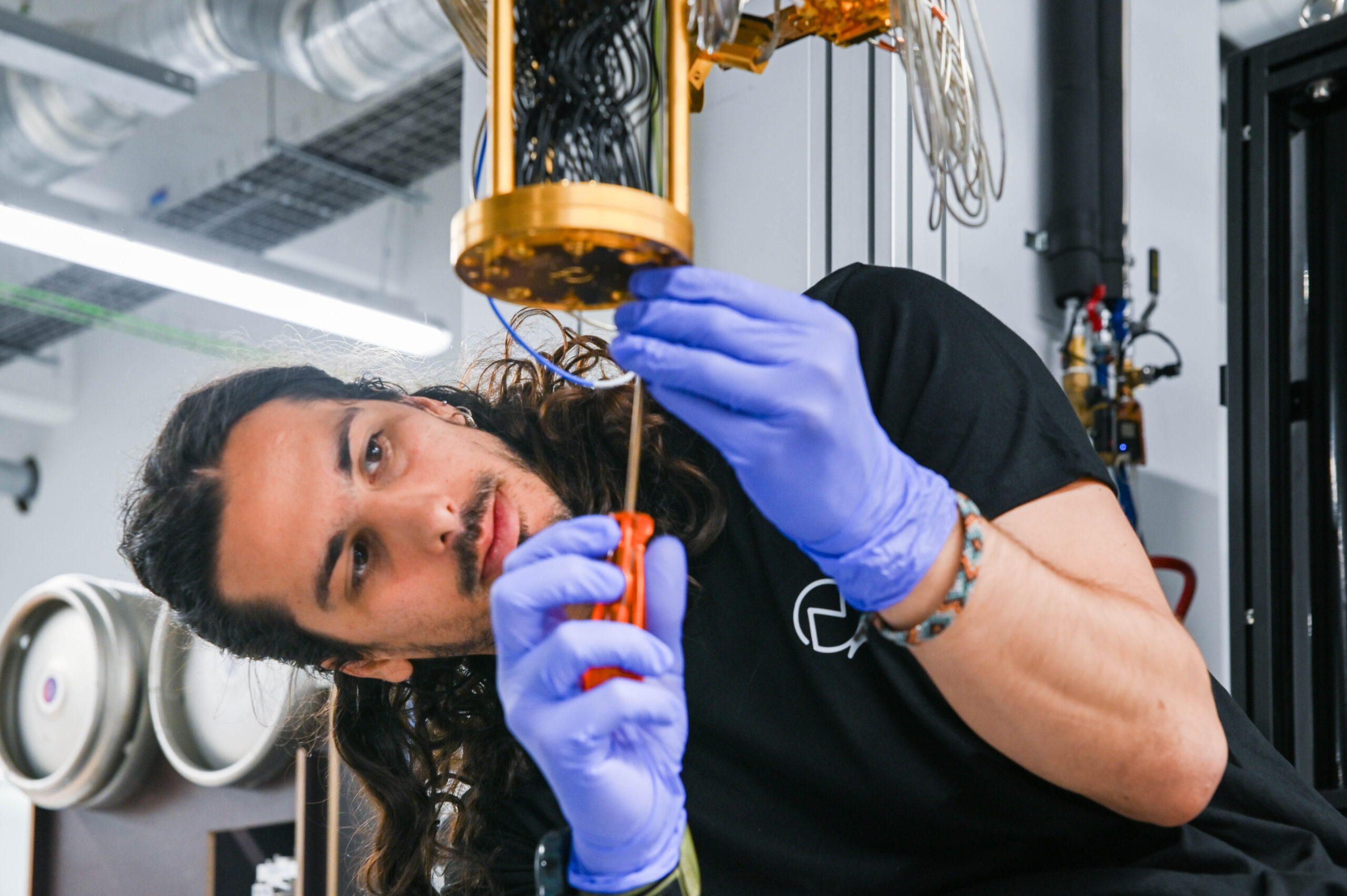
MareNostrum-ONA, the quantum computing infrastructure at the Barcelona Supercomputing Center (BSC-CNS), has completed its technological roadmap with the installation of a new 35-qubit processor, the final milestone of Quantum Spain. The system was built and deployed by Qilimanjaro and GMV, integrated into MareNostrum 5, and has been open to the research community from day one through the Red Española de Supercomputación (RES).
The development of the system is part of the Quantum Spain initiative, driven by the Ministry for Digital Transformation and the Civil Service through SEDIA.
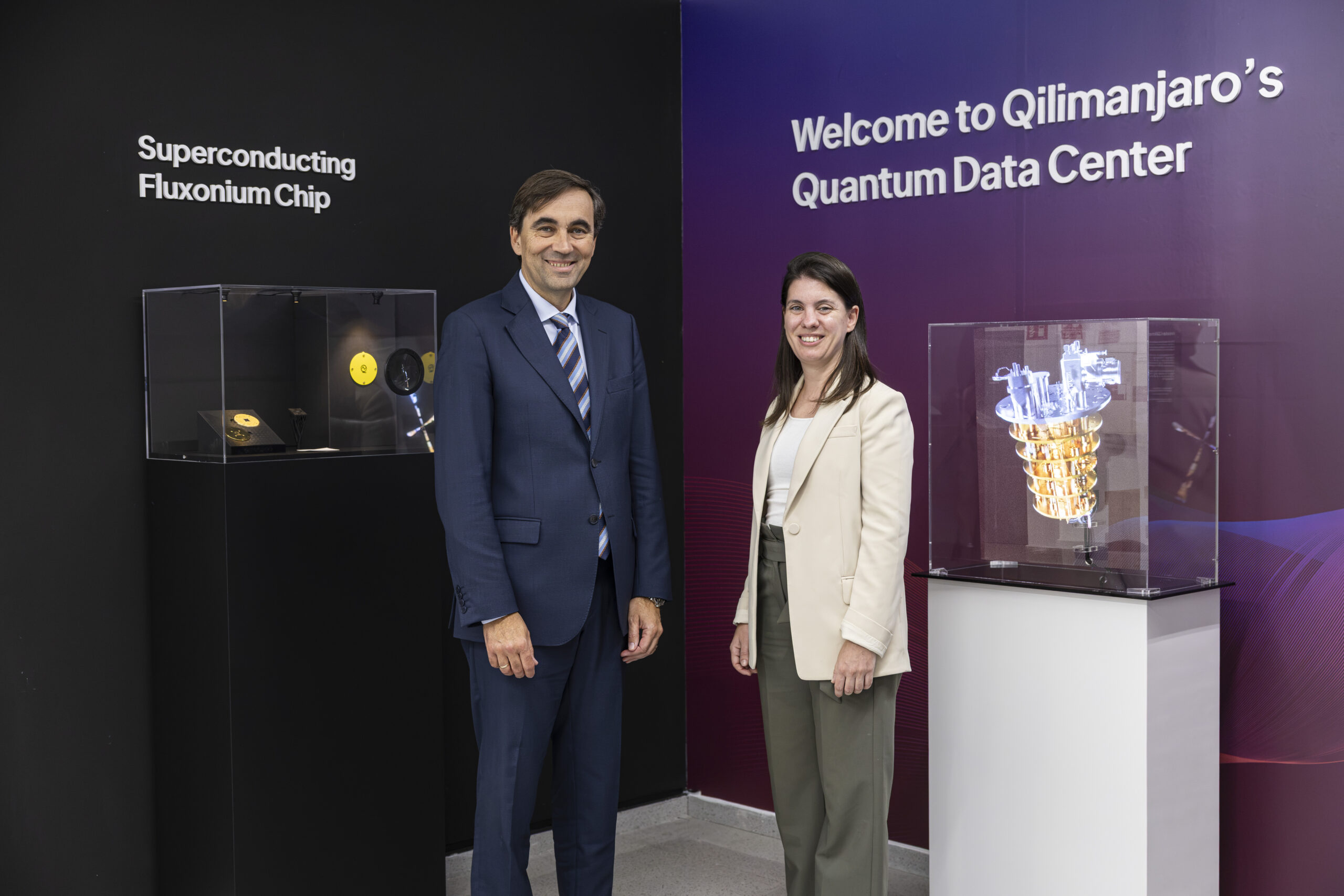
The 35-qubit processor at MareNostrum-ONA.
This system marks the shift from experimental quantum computing to operational quantum computing. Qilimanjaro, together with GMV and BSC, has demonstrated that Spain has the industrial capacity to produce, deploy, scale and maintain real quantum systems in production, integrated into one of the most powerful supercomputers in Europe. And above all, accessible from the very first day.
Marta P. Estarellas
CEO of Qilimanjaro
The infrastructure is running. Researchers are using it.
Since going live, the RES has granted access to over 45 projects, accumulating more than 4,000 hours of computing time. The results are already making their way into the scientific literature, with three recent studies that illustrate how broad and practical that usage already is.
Once MN-ONA was operational, Mar Tejedor and Dr. Rosa María Badía from the Workflows and Distributed Computing group at BSC, alongside Dr. Alba Cervera and Berta Casas, developed Qdislib. This library for distributed quantum circuit cutting decomposes large circuits into smaller subcircuits and runs them in parallel across CPUs, GPUs, and QPUs, designed to work seamlessly within hybrid quantum-classical HPC environments like MareNostrum-ONA.
One year later, the Workflows and Distributed Computing group published new results regarding the development of a Quantum Circuit Cache. This system detects semantic equivalence across quantum operations to eliminate redundant computation in large-scale hybrid workflows. Evaluated on the 35-qubit QPU of MareNostrum-ONA, it achieved an 11.2x speedup on real hardware by bypassing up to 91.98% of redundant subcircuit executions.
A research team co-led by Dr. Massimiliano Ferrara, Dr. Santiago Forgas Coll, and Dr. Laura Sáez Ortuño with the participation of Dr. Martí Sagarra and Valeria Isgrò amongst other researchers,applied quantum kernel methods to a real business problem: predicting venture quality in life-science equity crowdfunding. Their work included a direct hardware implementation on the Quantum Blue QPU at BSC, making it one of the first studies to benchmark results against physical quantum hardware on this infrastructure.
This work also marks a first: the first published article to come out of quantum access granted through the RES.
In Dr. Sáez’s own words:
Working with real quantum hardware at MareNostrum‑ONA has been a very valuable experience, especially to validate results beyond simulations. Access to the BSC infrastructure has been smooth and has allowed us to integrate the quantum processor within a hybrid HPC workflow, which is key for moving towards real-world applications. Having this kind of open environment available to the research community is extremely meaningful.
Dr. Laura Sáez
Researcher at the Universitat de Barcelona
The research team, Dr. Massimiliano Ferrara, Dr. Santiago Forgas Coll, and Dr. Laura Sáez Ortuño.
What comes next
Quantum Spain is complete, the infrastructure is open and results are coming out. But there is more coming.
MareNostrum-ONA is currently being expanded with a new analog quantum processor, also built by Qilimanjaro, as part of the EuroQCS-Spain node of the EuroHPC Joint Undertaking. Its inauguration is approaching. For researchers working on optimization and simulation problems, this will open a new set of possibilities on the same infrastructure, one that unifies digital quantum, analog quantum and classical computing.
Reaching 35 qubits at MareNostrum-ONA has been a major step forward for our research. It has allowed us to test significantly larger and more complex problems, while also giving us a much clearer view of how to integrate quantum hardware into our workflows in order to fully exploit the potential of quantum-HPC integration. This represents an important step towards the development of future hybrid workflows combining classical and quantum computing.
Mar Tejedor
PhD Student at BSC
Access to MareNostrum-ONA is available through the Red Española de Supercomputación (RES) and BSC’s access programmes.