Join Our Sessions in Denver
Next week, the Qilimanjaro team heads to the APS March Meeting.
The team will be presenting their latest work and connecting with the global quantum community. If you’re attending, stop by booth #1202 — we’d love to meet you.
Booth 1202
Denver, CO
March 16-21
Join us
Here’s our agenda of our talks this week!
TUE
17
March 2026

MARTA P. ESTARELLAS
CEO
09:30 - 11:00 a.m.
Convention Center, Meeting Room 502
Physics at Work for Humankind – Building Startups that Matter Panel Dicussion
This is a 90 min panel discussion that builds upon the previous session covering the following topics:
1. What is a physics startup?: Characteristics of a physics startup compared to other types of startups and to companies that have been running for a long time, Characteristics of physics entrepreneurs and their motivation.
2. Challenges in forming and building a startup: Developing the business concept, Defining the right approach to funding and getting funded, Forming the team, Getting support from incubators, accelerators, consultants, etc.
3. What do you need to know to manage and grow a startup?: Leadership / Team building / Company structure, Proposal preparation / Budgeting, Financial terms and reports, Program Management, Manufacturing, Sales and Marketing, Customers and commercial opportunity development, Intellectual Property (IP) protection, Risk management, Networking.
4. Lessons from my personal experience: Operation of a startup as part of an ecosystem, Personal anecdotes supporting some of the aspects above
WED
18
March 2026

LORENZO SCARPELLI
Senior Measurement Engineer
08:00 - 08:12 a.m.
Convention Center, Mile High Ballroom 4AB
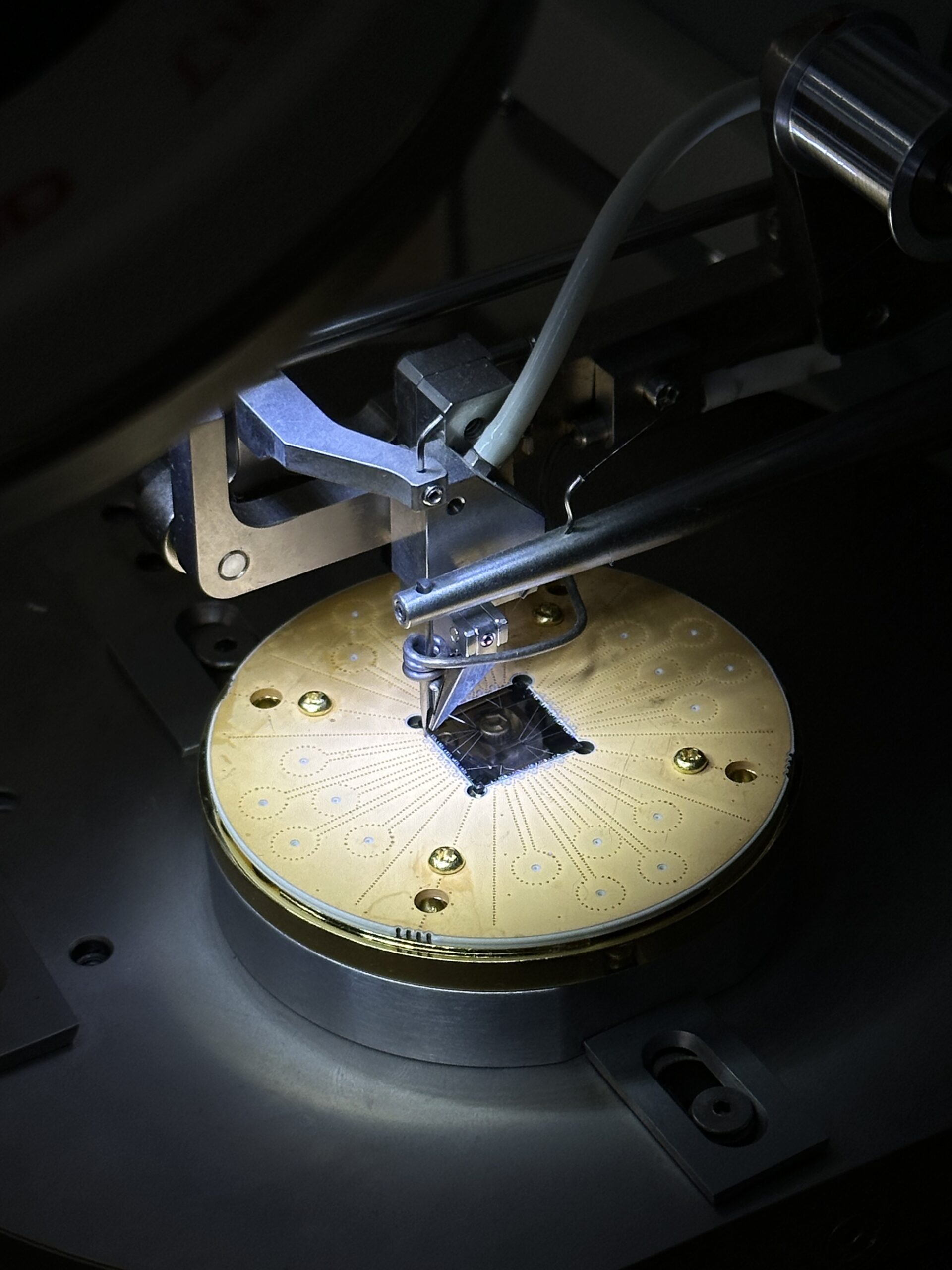
Flip-chip Fluxonium for Coherent Analog Quantum Computing
Analog quantum architectures impose stringent specifications on superconducting qubit systems: very long coherence times, strong connectivity, and fast, high-fidelity readout. Fluxonium qubits offer a promising route forward thanks to their low transition frequencies (0.1-1 GHz), large loop inductances, and high anharmonicity, which help suppress dielectric and flux noise. Recent experimental work has achieved coherence times approaching 1.5 milliseconds [1], and readout fidelities exceeding 90% [2].
In this talk, we present Qilimanjaro’s latest developments towards an analog quantum processor based on fluxonium qubits implemented in a flip-chip architecture. The platform is conceived to operate primarily in the analog regime, enabling coherent time evolution driven by engineered Hamiltonians, while still supporting digital-style control when required. We will present the device architecture, key design advances, and experimental results, highlighting the implementation concept, crosstalk calibration methods, and single- and multi-qubit performance.
MARTA P. ESTARELLAS
CEO

David Eslava
Head of Systems and Engineering
09:15 - 10:00 a.m.
Convention Center, Meeting Room 501
SpeQtrum at Barcelona Supercomputing Center: Embedding Quantum Nodes into HPC Infrastructure
SpeQtrum is Qilimanjaro’s multimodal quantum data-center stack, built to bring superconducting digital and analog quantum processing into a single, coherent execution environment and expose it through a unified interface. It combines interoperability with standard digital QPU providers with native access to Qilimanjaro’s unique fluxonium-based processors, engineered for analog control and continuous-time dynamics, to take the most out of each quantum backend.
A defining capability of SpeQtrum is cross-paradigm hybridization. The platform composes workflows across digital circuits, analog evolution and classical compute, enabling controlled benchmarking across backends. At the software layer, QiliSDK provides a single entry point to the stack, integrating with external SDK ecosystems while routing workloads to digital QPUs, analog QPUs, or classical targets from the same programming interface.
SpeQtrum is already deployed in a flagship integration at the Barcelona Supercomputing Center (BSC), demonstrating how quantum nodes can be embedded into leading European HPC infrastructure. This talk presents the platform architecture, backend model, and the product choices that enable scalable hybrid execution for the future of more sustainable and powerful data centers.
FRI
20
March 2026

JOSEP BOSCH
Senior Quantum Algorithms Engineer
01:00 - 01:12 p.m.
Convention Center, Mile High Ballroom 1C
A coherent approach to quantum-classical optimization
Hybrid quantum-classical optimization techniques, which incorporate the pre-optimization of Variational Quantum Algorithms using Tensor Networks, have been shown to allow for the reduction of quantum computational resources. In the particular case of large optimization problems, commonly found in real-world use cases, this strategy is almost mandatory to reduce the otherwise unfathomable execution costs and improve the quality of the results. We identify the coherence entropy as a crucial metric in determining the suitability of quantum states as effective initialization candidates. Our findings are validated through extensive numerical tests for the Quantum Approximate Optimization Algorithm, in which we find that the optimal initialization states are pure Gibbs states. Further, these results are explained with the inclusion of a simple notion of expressivity adapted to classical optimization problems. Based on this finding, we propose a quantum-classical optimization protocol that significantly improves the effectiveness of the quantum subroutine.
If you’re attending March Meeting, we’d love to see you there.
Let’s talk quantum!