Making the core concepts of quantum computing easier to understand.
Quantum computing is complex, but understanding the basics doesn’t have to be. This guide breaks down the key concepts to help you understand how it works.
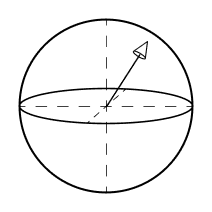
Qubit
A qubit is the quantum version of a bit: while a bit can only take the values 0 or 1, a qubit has two basis states |0⟩ and |1⟩ and can be in either of them or in a linear combination (or superposition) of both.

Superposition
In the classical world, a system is in a well-defined state (for example, a coin is either heads or tails). In the quantum world, the information we have about a system is compatible with it being in a combination of multiple states at the same time, until it is measured. Each state has a weight or percentage to which it can “collapse” during the measurement process.

Entanglement
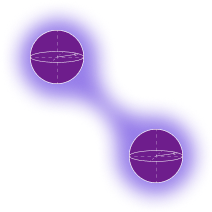
Two particles can become entangled so that, no matter how far apart they are, measuring one instantly affects the other. This quantum phenomenon is fundamental in applications such as quantum communications or quantum computing.
Coherence
It is the time during which a qubit can maintain its quantum state (superposition and entanglement) without degrading before environmental disturbances cause it to lose its information. Basically, it is the time during which the qubit can be used to perform calculations.

Decoherence
It is the phenomenon by which a qubit loses its coherence due to interaction with the environment (light, heat, noise, or measurement). Managing decoherence is essential to maintain the quantum state of qubits and to achieve reliable operations.

Quantum Computing
Quantum computing is a computing paradigm based on the laws of quantum mechanics, in which information is encoded in qubits and phenomena such as superposition and entanglement are exploited to process information in a way that differs from classical computing. It is not simply a faster supercomputer, but a different computational model that can offer advantages for certain classes of specific problems such as simulation, optimization, certain AI subroutines, and cryptography problems.
Physical Qubit
A physical qubit is a real quantum system, implemented in hardware, capable of encoding and manipulating information in two well-defined quantum states (|0⟩ and |1⟩). It is very sensitive to the environment and inherently noisy, so it suffers from decoherence and errors that limit the reliability of computations. There are different technological implementations of physical qubits, including superconducting circuits, neutral atoms, trapped ions, and photons, among others.
Logical Qubit
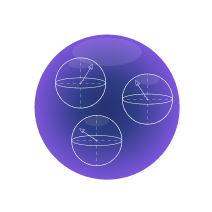
A logical (or “virtual”) qubit is a fault-tolerant unit of quantum information that encodes the state of a qubit across multiple entangled physical qubits using quantum error correction techniques. It is the key element for building scalable and reliable (fault-tolerant) digital quantum computers.
Full-Stack Quantum Computing
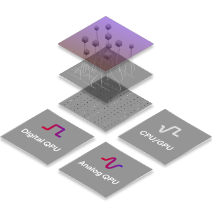
It is a comprehensive approach that encompasses the coordinated development of quantum hardware, electronic control, low- and high-level software, algorithms, and applications under a co-design strategy. This approach optimizes end-to-end system performance by aligning the physical architecture with programming layers and use cases, enabling faster achievement of practical advantage compared to fragmented models.
Classical–Quantum Integration (or Hybrid Computing)
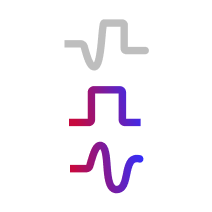
It is the model in which quantum computers operate as specialized accelerators within high-performance computing (HPC) infrastructures, delegating to the quantum processor (QPU) the subproblems where it can provide an advantage, while classical computing handles orchestration, pre- and post-processing, and workflow control.

Fluxonium Qubits
Fluxonium qubits are a type of superconducting qubit designed to improve stability and reduce sensitivity to noise. They use a circuit with a Josephson junction and a large inductance, allowing them to maintain their quantum state for longer periods. This makes them a promising approach for building more reliable quantum systems, especially in analog quantum computing.
Analog Quantum Computing
Analog quantum computing follows a different approach. Instead of applying discrete gates, the problem is encoded directly into a physical system, which is controlled continuously.
The system evolves gradually from an initial state to a final state that represents the solution. This continuous evolution can reduce certain types of errors compared to gate-based approaches.
This model is particularly well suited for problems like optimization and simulation. A key example is quantum annealing, where the system is guided toward the lowest energy state to find optimal solutions.

Digital Quantum Computing
Digital quantum computing is conceptually similar to classical computing: calculations are performed through a sequence of quantum gates applied step by step.
These gates are not physical circuits, but highly precise energy pulses (such as microwaves or lasers) used to control the state of qubits.
Because qubits are extremely sensitive to their environment, errors are unavoidable. To address this, digital quantum computing relies on error correction, where information is distributed across many physical qubits to form a more stable logical qubit.
While this approach is universal and can, in principle, solve any computable problem, it requires a large number of qubits to achieve reliable results.

Emulator
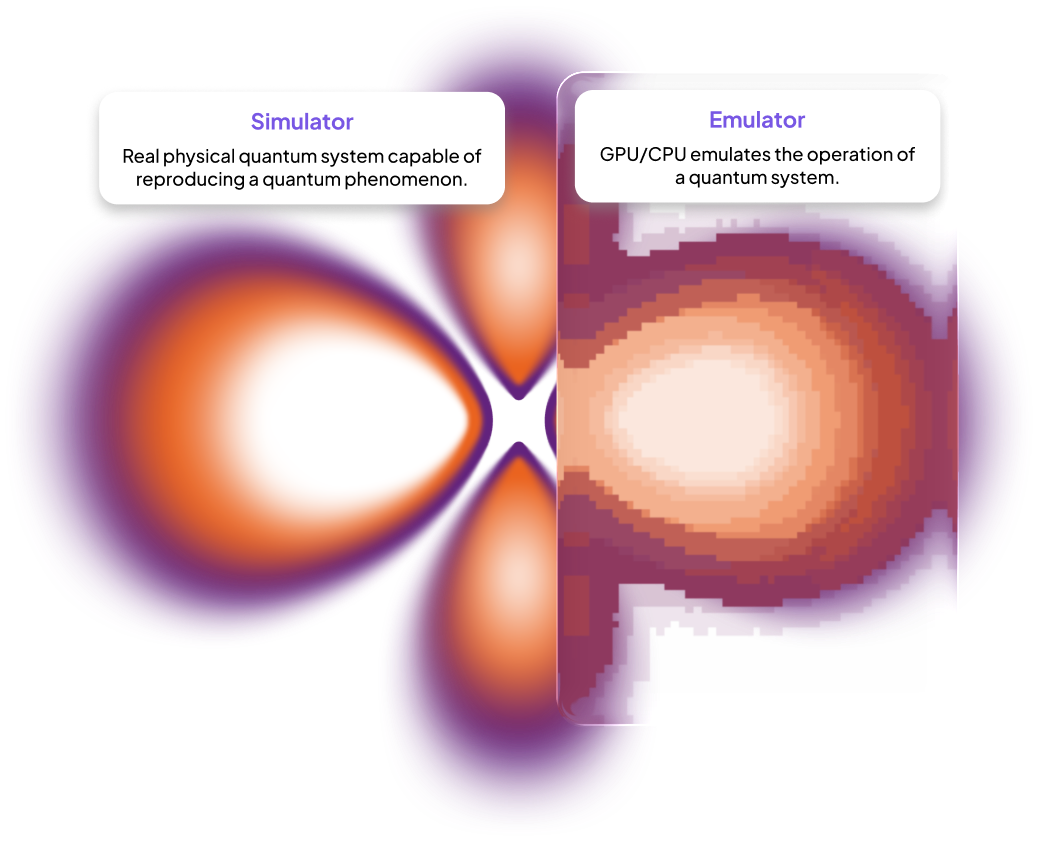
An emulator is a classical system that, using classical algorithms, aims to reproduce a quantum phenomenon. Such emulators work for specific quantum systems and under certain conditions, such as, for example, having little entanglement in the system we want to emulate. Entanglement is precisely one of the fundamental properties that characterize how “deeply quantum” a system is. When the degree of entanglement increases significantly, classical emulation becomes exponentially costly or even impractical. Therefore, emulators do not allow us to overcome the limitations of classical computers and cannot provide a quantum advantage.
Simulator
It is a device designed to emulate the quantum phenomena of a specific physical system. Unlike a universal quantum computer, it is not generally programmable; meaning it cannot run a wide variety of algorithms or protocols. Its function is limited strictly to replicating the behavior of the quantum system for which it was created. The quantum simulator runs on a specific-purpose quantum computer, which means it can provide a quantum advantage. The concepts of emulator and simulator are often confused in the field.
Quantum-inspired computing
Quantum-inspired computing involves using classical algorithms running on conventional computers (CPUs or GPUs) to emulate the behavior of a quantum system with a finite level of precision. This approach does not rely on quantum hardware or physical quantum phenomena.
One of the most well-known classical tools for approximating quantum systems is Tensor Networks. This mathematical formalization was originally developed to emulate the behavior of multi-particle systems. These techniques can represent certain complex systems in a compressed format and have found applications in areas like optimization and the compression of artificial intelligence models.
However, these methods have a well-known structural limitation: tensor networks are only efficient at emulating quantum systems when there is a limited level of entanglement between their qubits.
Consequently, while these techniques can offer computational advantages in specific contexts, they are approximations based entirely on classical computing resources. Because they do not operate on physical quantum states, they do not directly reproduce genuine quantum phenomena quantum advantage.
Digital Annealer
Simulated annealing can be considered the classical counterpart (or emulator) of the quantum annealing algorithm, even though it does not exploit quantum phenomena such as superposition or entanglement.
A Digital Annealer can offer performance improvements over general-purpose classical architectures for certain optimization problems. However, because these processors rely on conventional electronic technology, their operation falls entirely within the classical computing paradigm and cannot provide a quantum advantage.